Don’t Just Look at the Power of a Remote-Controlled Mower – The Real Brains Are in the Transmitter
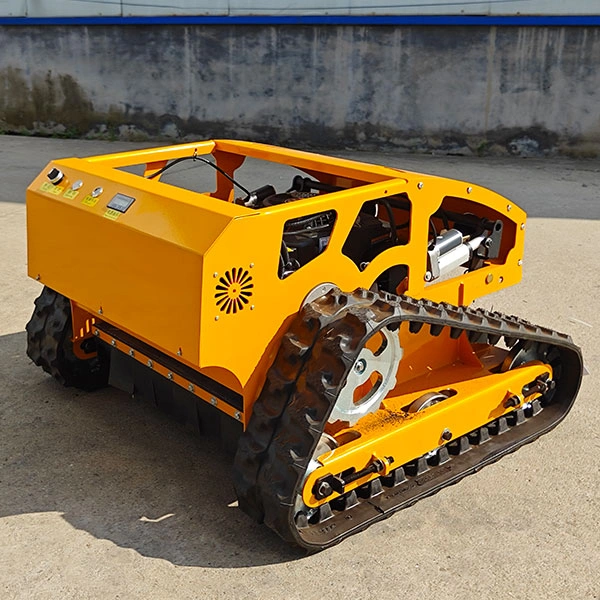
You’re standing on level ground, watching a remote-controlled mower work its way across a steep slope, chewing through thick grass without breaking a sweat. What you might not realize is that the reason that machine feels safe and responsive up there has very little to do with the blades. It has everything to do with the transmitter in your hands. A lot of people assume the transmitter is basically just a TV remote – point and click. But in commercial and pro-grade landscaping, the control system for a remote-controlled mower is actually a two-way, closed-loop command center. It doesn’t just take orders. It constantly reports back. And in some cases, it starts making its own decisions the moment you let go of the stick.
Not an On/Off Switch – More Like a Mini Flight Controller
Open up a professional-grade transmitter for a remote-controlled mower, and you won’t find simple forward/reverse switches. Instead, you’ll see two Hall-effect joysticks. Why joysticks? Because mowing isn’t turning a light on and off. You need fine control – faster or slower, a sharp turn or a gentle curve. Move the stick a millimeter, and the drive motors change by hundreds of RPM. That’s what actual control feels like. Alongside the joysticks, you’ll usually find dials with good mechanical resistance and a prominent kill switch. The dials adjust blade speed, while the kill switch is a hardware-level interrupt with the highest priority. This kind of layered input design essentially lets you assign different operating modes – transport, mowing, obstacle avoidance – to different physical controls. The remote-controlled mower isn’t forced to guess what you want from a single, overloaded control scheme.
It’s Not Just Broadcasting – It’s Handshaking
A common misunderstanding is that the transmitter yells commands, and the mower listens. A properly engineered system works on handshake protocol. Every time you move a joystick, the transmitter assembles a data packet – channel values, checksum, device ID – and sends it out. The onboard receiver doesn’t just blindly act on it. First, it verifies the packet integrity, then sends back an acknowledgment. If the transmitter doesn’t see that ack after a few attempts, it goes into an alert state. That means for every second you’re controlling that remote-controlled mower, the system is having a high-frequency conversation behind the scenes. This is also why industrial-grade systems never rely on standard Bluetooth or Wi-Fi – those protocols prioritize bandwidth. A remote-controlled mower prioritizes determinism. It’s better to be a little slower than to drop a packet at the wrong moment.
Why 2.4GHz and 433MHz Dominate This Space
You might wonder why almost every remote-controlled mower uses either 2.4GHz or 433MHz instead of just riding on a cellular 4G or 5G connection. The answer comes down to latency. Cellular networks have variable delay – anywhere from tens to hundreds of milliseconds. And remote mowing is surprisingly latency-sensitive. If you see the machine about to hit a wall and release the stick, but the signal takes a round trip over the cellular network, the impact may have already happened. 2.4GHz gives you higher bandwidth and faster response – good for high-end models with live video. 433MHz has better penetration through dense vegetation and trees. But the real core technology that makes a remote-controlled mower feel solid is frequency hopping. When a particular channel gets interference, the transmitter and receiver simultaneously jump to a clean channel according to a preset pseudorandom sequence. You never notice it happening.
The Real Difference Maker Is Failsafe Hardware
If a consumer Bluetooth speaker loses connection, it just reconnects. A remote-controlled mower is a different story – the blades are spinning at high speed, and they won’t stop just because the signal dropped. That’s why any legitimate remote control system has mandatory failsafe protection built in, and it’s not just software. Inside the receiver, there’s a hardware timer. Every time it receives a valid command, it resets that timer. If the timer expires – usually after about half a second without a clean signal – it triggers a hardware-level power cut that bypasses the main processor entirely. The remote-controlled mower brakes both the drive motors and the blade motor. It does not “hold last command.” This mechanism doesn’t depend on software, doesn’t depend on the processor not being locked up, and doesn’t depend on a battery management system behaving well. It’s just a timer, a comparator, and a relay. That’s real safety.
FPV Video Is Not Just a Camera Tacked On
Higher-end models are starting to offer first-person view (FPV) video, letting you sit in the shade and watch the screen while you mow. But there’s a subtle problem here: video consumes bandwidth, while control commands need low latency and high reliability. If you put both on the same wireless channel, a video glitch can actually delay or corrupt control packets. Mature systems physically separate the two – control stays on a dedicated low-bandwidth channel (often 433MHz or a reserved 2.4GHz link), while video rides on 5.8GHz or a separate digital Wi-Fi band. What that means in practice is that on your screen, you see the remote-controlled mower’s view of the world in real time, but every time you move a stick, those commands are traveling on a private express lane. The two paths don’t interfere. That’s the kind of design that lets you work remotely for hours without a nervous eye on the signal bars.
A Good Transmitter Is One You Forget About
Let’s go back to that opening scene. You’re standing in a safe zone, fingers resting lightly on the joysticks. Fifty yards away, the remote-controlled mower traces a perfect straight line along a row of trees, leaving clean, even grass behind it. You aren’t thinking about frequency hopping, or packet checksums, or hardware timer interrupts. You aren’t even glancing down at the transmitter’s status LEDs. A truly well-designed remote control system doesn’t impress you with a long feature list – it makes you feel like the machine is just an extension of your own hands. From the physical feel of the joysticks, to the redundant wireless link, to the hardware-level emergency stop, every single piece is engineered to shut down failure paths before they become problems. And that, more than horsepower or cutting width, is what separates a professional-grade remote-controlled mower from a toy.