
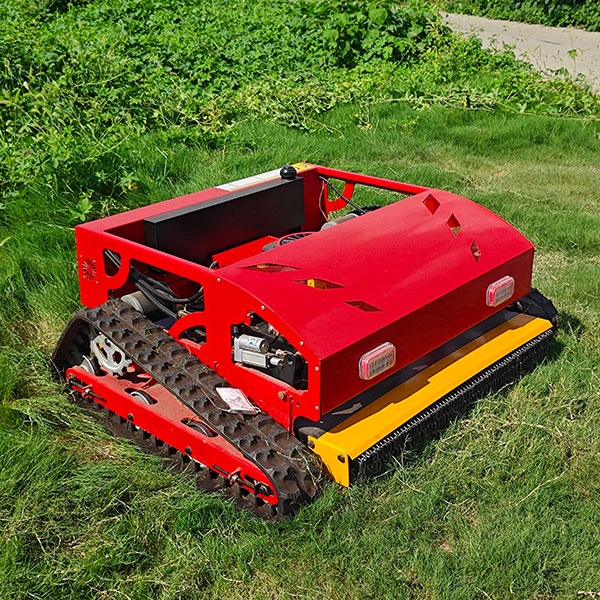
Q: What are the uses and structure of a remote-controlled lawn mower?
Q1: What problem does the tracked remote-controlled mower solve in the industry?
A: In sectors such as landscaping, agricultural forestry, and hydraulic slope protection, mowing has long been a routine but labor-intensive task. Traditional wheeled push mowers suffer from low efficiency and cannot handle complex terrains—including steep slopes, muddy ground, and uneven surfaces. They also pose significant safety risks, such as operator slips and mechanical rollovers. The tracked remote-controlled mower was developed in response to these challenges, leveraging three core strengths—all-terrain adaptability, remote operation, and high efficiency with enhanced safety—to overcome the limitations of conventional mowing and become the preferred solution for weed control in demanding environments.
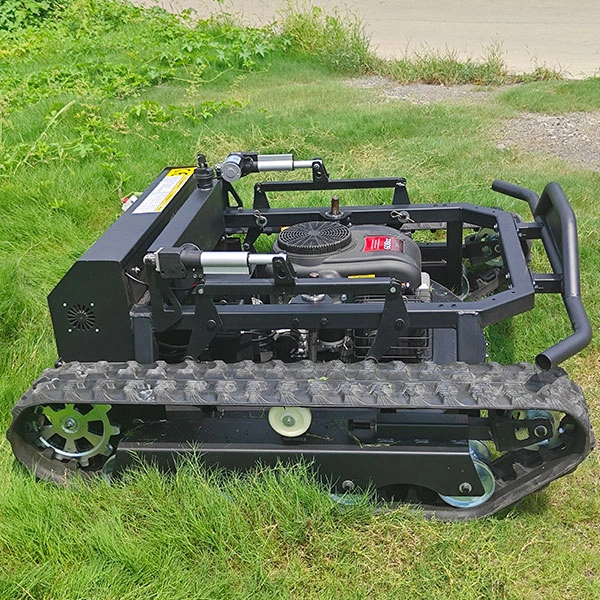
Q2: What are the main structural modules of this mower?
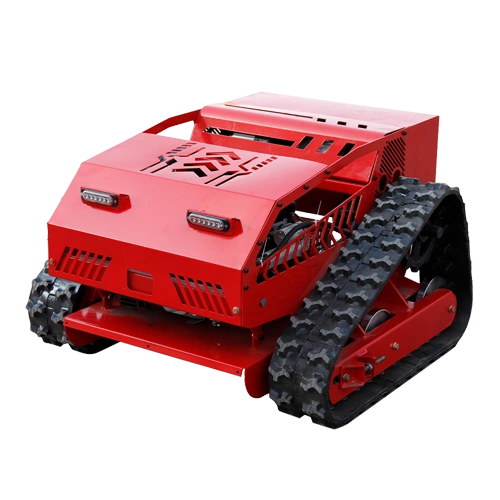
A: The machine is purpose-built around three design pillars—strong passability, easy maneuverability, and high stability. It consists of four primary systems:
- Traction (Undercarriage) System – The key differentiator. It uses high-strength rubber tracks reinforced with steel wire or fiber materials, combined with drive wheels, guide wheels, and tensioning devices. This design provides a large ground contact area and exceptional grip, with a ground pressure of only approximately 0.12 MPa. It prevents sinking in soft soil or sand and maintains firm traction on slopes to eliminate slipping and rollover risks. The tracked chassis also supports zero-radius turns, with a minimum turning radius of about 400 mm, enabling agile operation in narrow orchards, terrace ridges, and garden corners without repeated repositioning.
- Power System – Equipped with either a high-horsepower four-stroke gasoline engine or a brushless DC motor, delivering ample power and stable endurance. Gasoline models can operate continuously for over 5 hours, while electric models with range extenders achieve up to 1.8 hours of comprehensive runtime, meeting the needs of large-area continuous mowing.
- Cutting System – Uses manganese-alloy wear-resistant flail or rotary blades, which are sharp and impact-resistant. Cutting widths typically range from 500 to 800 mm, and the stubble height can be hydraulically or electrically adjusted between 2 and 20 cm. This allows the machine to trim fine lawns as well as shred tall weeds, shrubs, and straw up to 2 meters high, supporting mulching and returning organic matter to the soil.
- Remote Control System – Utilizes wireless radio frequency technology with an operating range of 150 to 200 meters. Operators can control all functions—forward, reverse, turning, deck lifting/lowering, and throttle adjustment—from a handheld transmitter, keeping personnel safely away from the mowing zone.
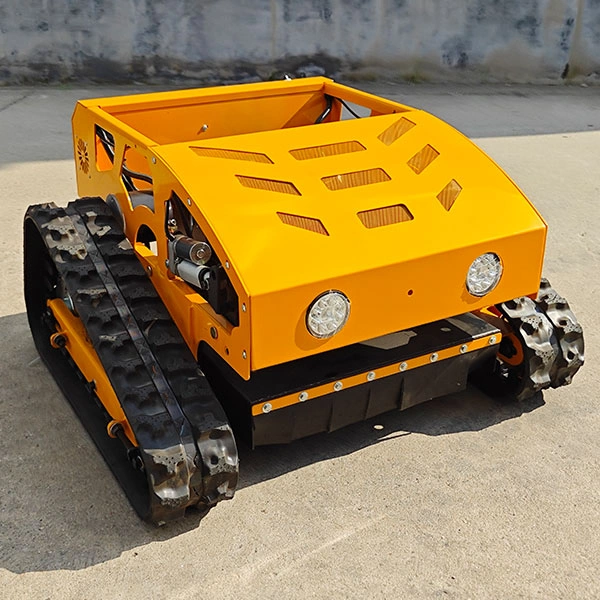
Q3: What are the key advantages over traditional mowers?
A: Compared to manual mowing and conventional wheeled mowers, this equipment delivers comprehensive upgrades in efficiency, safety, and adaptability:
- All-Terrain Capability – The most notable advantage. It operates smoothly on slopes of up to 35°–40°, as well as on muddy depressions, orchard ridges, and rocky hillsides. In contrast, traditional wheeled mowers cannot handle slopes exceeding 15°, and manual mowing poses serious safety hazards. The tracked design effectively resolves terrain-related mowing challenges across landscaping, farming, and hydraulic applications.
- Remote Operation for Maximum Safety – Operators are kept away from spinning blades and hazardous terrain, eliminating risks of slips, falls, cuts, and collisions—especially critical for embankments, slopes, and wasteland areas. The mower also features emergency braking and overload protection, with automatic shutdown upon encountering obstacles.
- High Efficiency and Cost Savings – Manual mowing covers only 1–2 mu (0.07–0.13 ha) per person per day, while conventional wheeled mowers handle 5–8 mu (0.33–0.53 ha) daily. This tracked model mows 4–6 mu (0.27–0.40 ha) per hour, achieving 30–40 mu (2–2.67 ha) per day—over 20 times the efficiency of manual labor. One machine can replace 8–10 workers, drastically reducing labor and time costs. The mulching function also eliminates the need for debris collection, further streamlining operations.
- User-Friendly Operation – No professional driving skills are required. The remote control features an intuitive layout, and operators—including elderly or female users—can become proficient after brief training. The compact, moderately weighted design facilitates transport and works across municipal landscaping, residential lawns, orchards, tea plantations, oil-tea groves, river embankments, highway slopes, and even land reclamation.
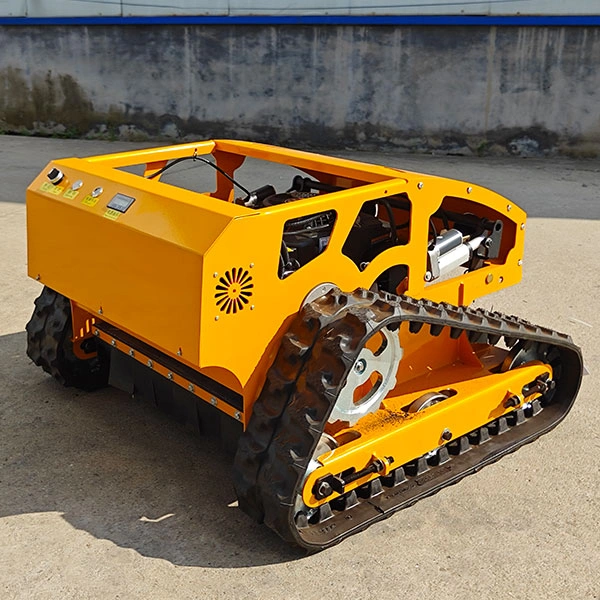
Q4: What are the primary application scenarios for this mower?
A: The mower’s strong adaptability makes it suitable for a wide range of sectors:
- Agriculture & Forestry – In orchards, tea gardens, and oil-tea groves, where traditional mowers cannot navigate narrow rows and manual cutting risks damaging crops. This machine moves easily between plants, precisely removes undergrowth, and returns shredded material to the soil—improving moisture retention and supporting eco-friendly cultivation practices.
- Landscaping & Greenspace Maintenance – For municipal parks, residential communities, villa gardens, and golf courses with complex layouts and dense plantings. It trims slopes and edges evenly, enhancing aesthetic quality while remote operation minimizes disturbance in public areas.
- Hydraulic & Municipal Infrastructure – On river embankments, highway slopes, and railway corridors where steep terrain and dense vegetation make manual work extremely hazardous. The mower operates stably on slopes, efficiently clearing weeds that could otherwise damage embankment or roadbed integrity. Agencies such as the Bincheng River Authority have already adopted it for levee maintenance.
- Specialized Uses – Also effective for wasteland reclamation, cemetery landscaping, ski-slope weed clearing, and other hard-to-reach areas where conventional equipment cannot operate.
Q5: What maintenance and operational precautions should be followed?
A: Proper care and correct operation are essential to extend service life and maintain performance:
- Pre-operation checks – Inspect track tension, blade sharpness, fuel/battery status, and remote-control signal to ensure all systems are functioning properly.
- During operation – Avoid hard obstacles such as rocks, tree stumps, and metal objects to prevent blade damage. On steep slopes, operate in a longitudinal or diagonal pattern rather than traversing sideways to reduce rollover risk.
- Post-operation cleaning – Remove grass clippings, mud, and debris from the body, tracks, and cutting deck. Check blade wear, and regularly change engine oil, replace filters, and lubricate tracks and rotating parts.
- Long-term storage – Drain fuel (for gasoline models) or fully charge batteries (for electric models), and store the machine in a dry, ventilated area away from direct sunlight and rain.
Q6: What are the future trends in this product category?
A: As the landscaping machinery industry moves toward intelligence and sustainability, tracked remote-controlled mowers are evolving accordingly:
- Smart features – Higher-end models now integrate BeiDou navigation, binocular depth cameras, and automatic obstacle-avoidance systems, enabling autonomous path planning and fully automated operation without manual remote control.
- Electrification – Battery-powered versions are gaining popularity, offering lower noise and zero emissions to align with environmental regulations.
- Improved control systems – More responsive electronic controls enhance operational precision and stability.
- Growing market demand – With increasing needs for hilly and mountainous farming, as well as urban green-space maintenance, the market for tracked mowers continues to expand. Product cost-performance is steadily improving, transitioning these units from specialized professional equipment to affordable solutions for household and agricultural use.
Conclusion
The tracked remote-controlled mower fundamentally transforms traditional mowing by combining all-terrain adaptability, remote-controlled safety, and exceptional efficiency. It effectively liberates labor while elevating professionalism and safety in complex mowing environments. Whether for agricultural planting, landscape upkeep, hydraulic infrastructure, or land reclamation, this machine proves to be a versatile and indispensable tool for modern green maintenance. As technology advances, it will continue to drive the mowing industry toward smarter, safer, and more productive practices.