
- Home
- Industry
- Bulk-Material Loading & Unloading
- Bulk Loading: Hopper, Conveyor and Dust
Bulk Loading: Hopper, Conveyor and Dust
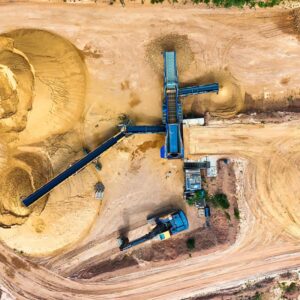
Bulk loading is a flow problem with a dust problem attached. Hopper angle, belt width and extraction decide rate and whether neighbours complain.

Bulk loading fails at the hopper far more often than at the belt. Material that bridges, ratholes or floods stops the line, and no amount of conveyor capacity recovers it. Three parameters decide: hopper angle, outlet size and the moisture of what you are handling.
1Why it matters
A conveyor is a fixed-capacity device; a hopper is a variable one. Design the hopper for dry sand and run damp sand through it, and the outlet arches within an hour. Design it for damp sand and run dry material, and it floods the belt. Both failures look like equipment faults and are actually specification mismatches.
2The three hopper parameters
| Parameter | Rule of thumb | Consequence if wrong |
|---|---|---|
| Wall angle | 55–70° from horizontal for most bulk solids | Bridging and ratholing |
| Outlet size | ≥ 3× the largest lump, more for cohesive material | Arching |
| Liner | UHMWPE for sticky, steel for abrasive | Build-up or wear |
Mass flow (all material moves) versus funnel flow (a channel forms) is the design choice that matters: mass flow needs steeper walls and more headroom, funnel flow is cheaper but leaves stagnant material that can degrade or self-heat.
3Matching belt to rate
| Belt width | Typical capacity (bulk density 1.6 t/m³) | Note |
|---|---|---|
| 500 mm | 60–100 t/h | Light duty, short runs |
| 650 mm | 120–200 t/h | Common yard duty |
| 800 mm | 200–350 t/h | Plant feed |
| 1,000 mm | 350–600 t/h | Main lines |
Capacity depends on belt speed, trough angle and surcharge; the figures above are indicative. Dust extraction is sized on the transfer points, not the whole line — three or four extraction hoods usually cover a yard conveyor.
4Where bulk systems go wrong
- Hopper designed from a catalogue. Angle and outlet must follow the actual material’s moisture and cohesion.
- Dust control added after complaints. Enclosures and extraction belong in the layout.
- Belt sized for peak. Running a wide belt at 30% load wastes power and wears edges.
- No surge capacity. A loader dumping in batches needs a hopper that buffers, not one that passes straight through.
5Numbers to fix before you enquire
| Item | Range | Effect |
|---|---|---|
| Throughput | 50–600 t/h | Belt and hopper size |
| Bulk density | 0.8–2.4 t/m³ | Capacity and structure |
| Moisture | 0–15% | Hopper angle |
| Max lump | 20–300 mm | Outlet and belt width |
| Receiving unit | Truck, ship, rail | Loading arrangement |
6Tools & next
Send the material specification — density, moisture, lump size — and the receiving unit; we will return a hopper and belt arrangement with the flow regime stated. Related reading: stockyard loader selection, and how dust affects enclosed conveyors.
Key facts. Bulk loading performance is decided at the hopper. Three parameters govern it: wall angle, typically 55–70° from horizontal for most bulk solids; outlet size, at least three times the largest lump and larger for cohesive material; and liner choice, with UHMWPE for sticky material and steel for abrasive. Mass-flow hoppers prevent stagnant material but need steeper walls and more headroom, while funnel-flow designs are cheaper but leave material that can degrade or self-heat. Indicative belt capacities at 1.6 t/m³ bulk density run from 60–100 t/h on a 500 mm belt to 350–600 t/h at 1,000 mm. Dust extraction is sized on transfer points rather than on the whole conveyor, and needs to be part of the layout rather than a retrofit. This article covers hopper and conveyor selection only; it does not cover structural design, explosion protection or ship loading.
Safety: bulk handling involves entrapment, dust and noise hazards; conveyors require guarding and pull-cord stops, and silos require entry procedures. Figures are for planning only.
Published 25 November 2026 · 4 min read · Industry column.
On this page
Need this checked against your site?
Send the working condition, the quantity and the destination port. The desk answers with a written specification and a traceable price — not a brochure.
Sourcing for this application
Tell us the machine, quantity and destination. We match audited factories, return comparable quotations, and handle inspection and freight if you need them.